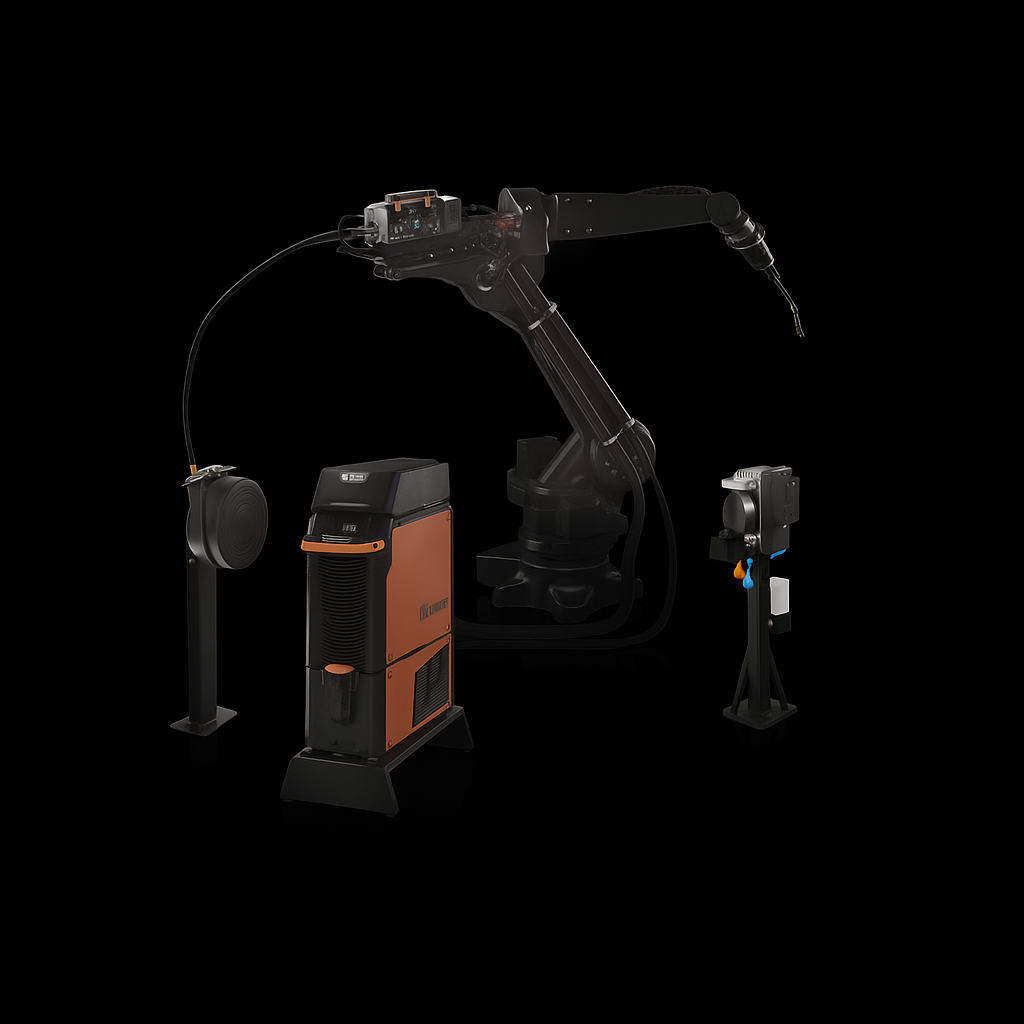
NeuraVision Track
Camera-based seam detection and path correction
Camera sensing determines the actual position and geometry of the seam. Instead of only following the taught path, the robot adjusts its motion to the real workpiece.
Complete robotic welding systems for steel and aluminium structures. Camera-based seam tracking, adaptive welding technology and full integration – from design to commissioning.
We design a complete robotic welding system around the workpiece, the production volume and the quality requirements. Mechanics, robot, welding technology, safety and control are engineered as one integrated system.
Robot reachability, collision risks, motion sequence and expected cycle time are verified before anything is built. Digital simulation reduces project risk and speeds up on-site commissioning.
We integrate the robot cell end to end – from the welding power source through the PLC and HMI to the production data links. The goal is not a standalone machine but a stable, documented production solution.
In series production, workpieces are never quite identical: seam position, gap width and joint geometry all vary. Neuraweld's intelligent technology senses these deviations, corrects the robot path and – where the application calls for it – adapts the welding parameters to the actual seam.
Camera-based seam detection and path correction
Camera sensing determines the actual position and geometry of the seam. Instead of only following the taught path, the robot adjusts its motion to the real workpiece.
Adaptive welding for varying seam geometry
Our in-house control algorithm can adjust travel speed, wire feed speed and weaving parameters based on the measured gap width and seam width. The intervention rules are configurable for each welding task and process.
Welding data and full traceability
The system logs the production recipe, the welding parameters and the key process events against each workpiece. The data serves quality assurance reports, process improvement and enterprise systems alike.
Our three product families cover flexible cobot welding, gantry welding of large structures and precision laser welding. Every system is configured for the workpiece, the production volume and the required level of automation.
Intelligent gantry welding system for large structures and long seams. Servo-driven axes, robot or welding-head integration, camera-based seam tracking and optional automatic material handling.
Flexible robotic welding system for small and medium batches. As a mobile cobot station, or as an installed cell with positioner, welding table and full safety integration.
Enclosed robotic laser welding cell for precise, thin-walled steel, stainless steel and aluminium parts. Low heat input, minimal distortion and high welding speed.
NeuraVision Track camera-based seam tracking · NeuraAdaptive Weld adaptive parameter control · NeuraTrace data logging and traceability
Welding aluminium demands precise fit-up, stable wire feeding and tightly controlled heat input. Neuraweld robot systems support repeatable production with application-specific welding technology, camera-based seam tracking and adaptive parameter correction.
Neuraweld systems are not catalogue machines: each one is built around the specific workpiece, quality requirement and production process.
Robotic welding of large, long and repetitive seams with documented welding processes and traceability.
High-mix parts, three-dimensional seams supported by fixtures and positioners, automatic changeover.
Gantry or robot cell welding of heavy-duty structures, long seams and varying geometry.
Automated MIG or laser welding of precise, thin-walled and heat-sensitive parts.
Revomatic holds a certified welding background for work related to the manufacture of rail vehicles and their components. Our engineering, robotics and welding technology competence supports documented, repeatable automated welding in one system.
Our simulation and operations services are available on their own, for existing robot systems, and as part of complete Neuraweld projects.
Digital cell model, reachability and collision analysis, offline robot programming and cycle time analysis before anything is built. Simulation reduces technical risk, speeds up commissioning and makes the investment more transparent.
Preventive maintenance, remote diagnostics, on-site support, operator and programmer training, and continuous improvement of the welding process. Service level and response time are matched to the system and the production need.
Our welding engineering, mechanical design, robot programming and electrical/PLC competence stays in one pair of hands – from concept through simulation and trial welds to operation.
Concept, design, robot programming, welding technology, integration and commissioning are all parts of one coordinated project.
We complement camera-based seam tracking with our own adaptive motion and parameter control, configured for the specific welding task.
Kemppi welding technology, ABB and FANUC robot platforms, and task-specific sensing and automation solutions.
Recipe management, process logging and traceability aligned with quality assurance and production requirements.
We work in a milestone-based project process. Every major technical decision is backed by simulation, a trial weld or a jointly approved test.
We get to know the workpiece, the current welding process, the production volume, the quality requirements and the goals to be achieved.
We prepare the cell concept and, where needed, run a simulation and a trial weld on the customer's own workpiece.
We design and build the cell and integrate the robot, the power source, the positioners, the safety system and the controls.
We verify operation with FAT and SAT tests, hand over the documentation, train the operators and provide the necessary service support.
In a 30-minute engineering consultation we review the workpiece, the current technology, the production volume and the automation options. If you have a drawing, 3D model, photo or welding video, you can send it ahead of the meeting.